There’s a particular kind of cricket story that Indian fans have a real soft spot for — the domestic run-machine who scores mountains of runs season after season, gets ignored by the national selectors for reasons nobody can quite articulate, and then finally gets a phone call. Sarfaraz Khan has been living that story for the better part of three years now, and this week it took another turn. He’s back in India’s Test squad, called up as a replacement for the injured Sai Sudharsan ahead of the two-match series in Sri Lanka, starting August 15 in Galle.
For anyone who’s followed his career even loosely, the reaction to this news wasn’t surprise. It was closer to relief, mixed with a healthy dose of “finally.” And also, if we’re being honest, a little bit of exhaustion — because this isn’t the first time Sarfaraz has had to fight his way back into a conversation he probably never should have been dropped out of.
The Numbers Nobody Can Ignore
Let’s start with what actually got him here, because it isn’t sentiment. Sarfaraz averages 64.73 in first-class cricket across 62 matches. That’s not a good number, that’s an absurd number — the kind of average that, in most cricketing nations, would have got a player a permanent Test spot years ago and kept him there through thick and thin. He’s scored double hundreds, he’s scored fourth-innings hundreds under pressure, he’s dragged Mumbai out of trouble more times than the Ranji Trophy record books probably bother to note individually anymore.
And yet, in six Tests for India, he’s managed only 372 runs. His last appearance came against New Zealand in Mumbai back in November 2024 — a series, worth remembering, where India were bowled out cheaply and blanked 3-0 at home, one of the more chastening results in recent memory. Sarfaraz wasn’t the reason for that defeat, not by any stretch, but the fallout from that series reshaped a lot of selection thinking, and he became one of the names quietly pushed to the margins.
He was picked for the Border-Gavaskar Trophy tour of Australia in 2024-25. He didn’t play a single Test on that tour. Five matches, and the team management never found a reason — or never explained one, at least — to hand him a game. Former India opener Aakash Chopra put it about as bluntly as anyone in Indian cricket media has: India wrote the kid’s obituary without ever giving him the chance to fail. That line stuck, because it captured something real. Sarfaraz hasn’t failed at the highest level. He’s simply not been given enough rope to succeed or fail on his own terms.
What Changed
So why now? A few things lined up, and it’s worth being clear-eyed about all of them rather than pretending this is purely a reward for domestic form.
The immediate trigger is injury. Sudharsan, who had established himself at No. 3 and was in excellent touch — two centuries in as many unofficial Tests for India A against Sri Lanka A — picked up a toe stress reaction during that tour last month. He’s been working through rehab at the Centre of Excellence in Bengaluru, and despite progress, wasn’t deemed ready in time for the Sri Lanka series. That opened a door. Ruturaj Gaikwad was reportedly considered as an option too, but his returns in that same India A series — 22, 1, and 13 — didn’t exactly build a compelling case. Sarfaraz’s record on spin-friendly surfaces, and Sri Lanka is expected to offer exactly that kind of turning, low-bounce cricket, made him the more obvious pick once fitness and form were weighed together.
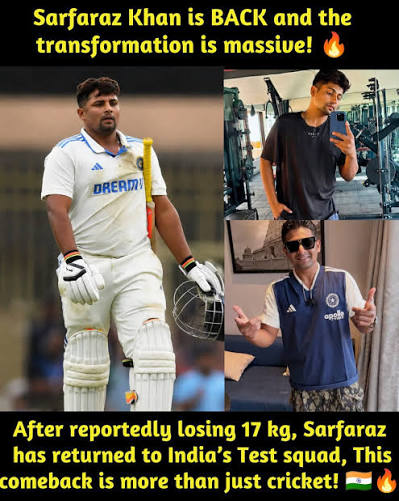
And fitness is the second part of this story, one that doesn’t get talked about enough given how much noise it’s created in the past. Sarfaraz has, by most accounts, undergone a genuine physical transformation this year — shedding a noticeable amount of weight and working seriously on his conditioning after years of criticism about his fitness levels. It’s easy to be cynical about these narratives in professional sport, but when a player’s own coach, his father Naushad Khan, has literally spent years driving him to camps and staying up late for net sessions, the emotional weight behind that Instagram post — Sarfaraz in the travelling jersey, his father sitting beside him — reads as more than just image management. It reads like a family that has been grinding toward this specific moment for a very long time.
The Bigger Picture India Is Operating In
Context matters here too, and the context isn’t flattering. India have had a rough stretch across formats — a Test series defeat to South Africa in November 2025, an ODI series loss to New Zealand in January 2026, and a T20I series defeat to England more recently. None of that is Sarfaraz’s fault, obviously, but it does change the mood around selection. When a team is winning comfortably, there’s little appetite to shake things up for a domestic run-scorer knocking on the door. When results start slipping, suddenly those knocks get heard a lot more clearly. Selectors under pressure tend to remember the names they’d conveniently forgotten.
There’s also the small matter of competition within the squad itself. Devdutt Padikkal scored a century in India’s warm-up fixture ahead of the series, which complicates things for Sarfaraz almost immediately. Getting recalled to a squad and actually forcing your way into a playing XI are two very different battles, and Sarfaraz may find himself watching from the dressing room for at least the first Test while team management figures out its middle-order combination. That would be a cruel irony — recalled after two years in the wilderness, only to sit and watch again — but Indian cricket has a long history of exactly that kind of irony, so nobody should be shocked if it plays out that way.
Can He Actually Prove Himself This Time?
Here’s the honest question underneath all of this: even with an opportunity, can Sarfaraz actually convert it into something lasting?
His game, at its best, is built for exactly these conditions. He’s a natural against spin, comfortable using his feet, unafraid to hit over the top when the situation calls for aggression rather than caution — which, in a low, turning Galle track, is exactly the kind of method that tends to separate batters who merely survive from batters who actually score. His unbeaten 150 that Mumbai fans still talk about, the one where he walked back to a standing ovation after finally getting out, is the sort of innings that tells you everything about his hunger. He doesn’t play like a man worried about his place. He plays like a man who assumes runs are coming and just needs the opportunity to collect them.
The lingering question marks are less about technique and more about scrutiny that’s arguably unfair. There’s a perception, fed by pundits and social media alike, that his game against high pace and extra bounce hasn’t been tested enough — a fair point, given he was never actually played in Australia despite being on that tour. It’s the kind of criticism that becomes self-fulfilling if selectors never actually put it to the test. Sri Lanka won’t answer that particular question definitively; the conditions there favour his strengths rather than exposing whatever weaknesses he may or may not have against extreme pace. But it will answer a different, arguably more important question first: can he simply walk back into international cricket after two years out and produce runs when it matters, under the kind of pressure that comes with being a recalled, scrutinised, slightly written-off player trying to remind everyone why he was ever picked in the first place?
Why This Story Matters Beyond One Player
There’s something bigger tangled up in Sarfaraz’s recall too, something about how Indian cricket treats its domestic circuit. The Ranji Trophy still produces genuine match-winners, players whose numbers are too good to explain away, and yet the gap between domestic excellence and a settled international career keeps widening for certain kinds of players — particularly those who don’t fit a conventional physical mould or whose game looks slightly unconventional on paper. Sarfaraz, at 5 feet 5 inches, has never looked like a textbook Test batter, and there’s a case to be made that this has cost him chances a taller, more classically-built player with similar numbers might not have lost.
If he goes to Galle and scores runs — even one substantial innings, one that shows composure against the turning ball under real pressure — it won’t just be a personal redemption story. It’ll be a small but meaningful referendum on how selectors weigh domestic form against reputation, and whether Indian cricket is actually willing to trust its numbers rather than its narratives. If he fails, or worse, doesn’t get a game at all, the frustration that’s built up around his career over the last two years will only deepen, and rightly so.
Either way, this is a moment worth watching closely. Not because Sarfaraz Khan is the most talked-about name in Indian cricket right now — he isn’t, not with a new Test captaincy era and a fresh WTC cycle dominating headlines — but because his story is quietly one of the more honest tests of whether the system actually rewards what it claims to value. Runs are runs. He has plenty of them. The only question left is whether India finally lets him turn domestic runs into the international career his numbers have been arguing for all along.