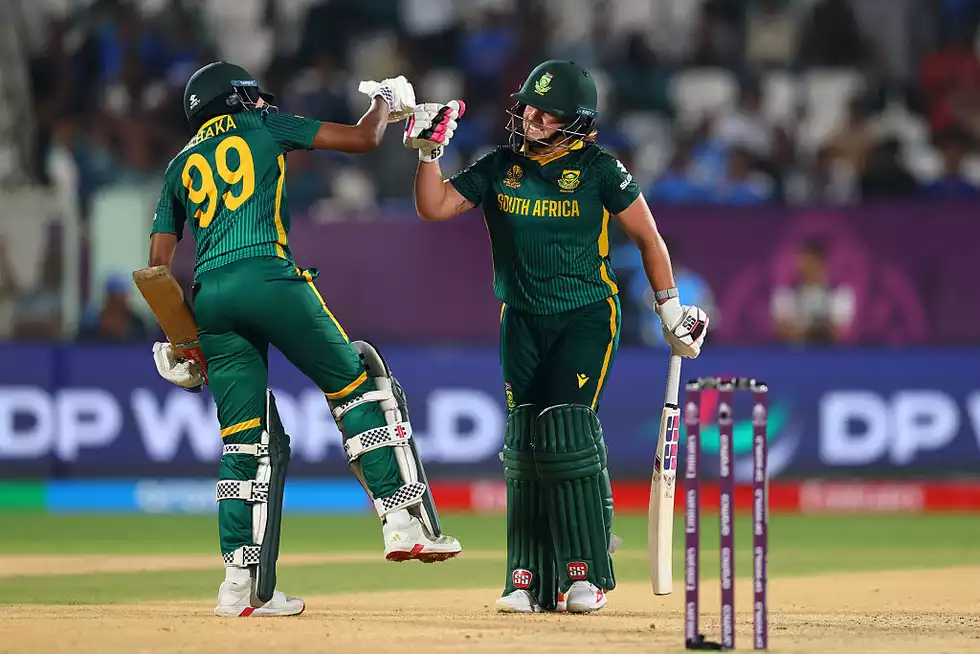
Richa Ghosh lit the night first. Her fearless 94 off 77 pushed India to a fighting total and felt, for long stretches, like the defining act of a tense World Cup contest. But when the chase tightened and the pressure spiked, Nadine de Klerk turned the game on its head with an audacious counterpunch — an unbeaten 84 off 54 that transformed South Africa’s pursuit from flickering hope into full-blown belief.
What stood out wasn’t only the volume of de Klerk’s runs but the timing. She arrived with the equation tilting India’s way, then rewired the narrative with clean, uncluttered hitting through the ‘V’, fearless pickups over midwicket, and late-hands slices behind point. Each option looked pre-planned, each risk measured. This wasn’t slog; it was a blueprint delivered at high speed, the kind that drains energy from fielders and belief from bowlers. By the time the last few overs rolled around, South Africa’s dressing room was on its feet, and India’s field had the ragged edges of a side suddenly short on answers.
Across the aisle, Ghosh’s innings was every bit as compelling — the classic rescue act that begins in turbulence and ends in a roar. She rebuilt, then accelerated, threading gaps with balance and power, forcing South Africa to reshuffle plans. That her effort didn’t end in victory says more about the game’s knife-edge than any failure of intent. On another night, 94 would headline the script. Here, it became the spark that summoned de Klerk’s blaze.
If Ghosh embodied fire, de Klerk embodied fight. The chase swung decisively during a pivotal late over when momentum, once guarded by India, was ripped free. The ball suddenly sounded different off de Klerk’s bat — a thud that carries distance and certainty. Fielders were pushed deeper, lines grew tentative, and lengths shortened just enough for her to pounce. It was clinical pressure management: break the rope once, then twice, then make the bowler second-guess every next delivery. The scoreboard began to gallop, and with it, South Africa’s composure.
There was mature game awareness, too. Between big shots, de Klerk stole busy ones and twos, refusing dot-ball clusters that so often choke late chases. She looked unhurried between deliveries, resetting quickly, chatting just enough with her partner to keep the plan tidy. Later, she’d call it “smart cricket,” which is as close as an athlete gets to admitting the chaos never quite seeped in. The eye test agreed — a player reading fields, not just reacting to them.
For India, this night becomes a dossier for reflection rather than regret. The bowling plans for the death overs will attract review: lengths at the base of the stumps, change-ups disguised late, and the sequencing of matchups against a right-hand power finisher who likes anything fractionally short or too full. The margins weren’t wide — a handful of deliveries separated control from scramble — but tournament cricket is ruthless about inches. The lesson is familiar: defend the pockets where a hitter wants the ball, and don’t let one boundary snowball into an over.
The broader takeaway sits at the heart of modern white-ball strategy: two match-defining knocks can coexist in the same game, and the second one usually wins. Ghosh’s surge set a par that would beat most sides on most nights. De Klerk’s reply simply existed at a rarer altitude — intent aligned with execution under severe time pressure. Teams build seasons around that kind of finishing clarity.
There’s also a human layer here. Momentum was punctured, briefly, by stoppages, treatment breaks, and tactical recalculations — moments that can fray concentration. South Africa used those pockets to breathe, to recalibrate, and to keep de Klerk’s options wide open. India, by contrast, found themselves chasing the game’s tempo once it flipped. In elite contests, the side that controls time — not just runs — often controls the result.
When the dust settled, the scorecard showed a three-wicket win for South Africa and two innings that will travel with this tournament. For India, there’s comfort in the quality of Ghosh’s batting and the knowledge that the blueprint is sound. For South Africa, there’s validation — a finisher with range, a chase under lights, and belief banked for the next tight finish.
From fire to fight: one player lit the evening, the other conquered it. On nights like these, cricket remembers both — but it belongs, indelibly, to the one still there when the winning runs are struck.